
Original Source
Ministry of Health Announces Public Call for 'AX Sprint' Project for Chronic Disease Patients
Ministry of Health to Promote AX Transformation Project for Chronic Diseases
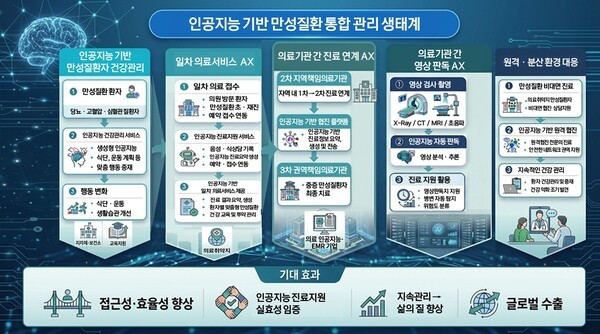
The Ministry of Health and Welfare, under Minister Jeong Eun-kyeong, announced the full-scale implementation of the 'AI Transformation (AX) Project for Healthcare Lifecycles Targeting Chronic Disease Patients' as part of the 'AI Application Product Rapid Commercialization Support Project (AX-sprint)'. This initiative aims to apply AI transformation across the entire healthcare spectrum, from daily health management for citizens to specialized medical services provided by university-level hospitals. With a total budget of 9 billion KRW, financial support will be provided for the practical demonstration of 5 distinct types (total 6 tasks).
Five Types of AI-Based Healthcare Improvement
The project is categorized into five main types. First, the 'Chronic Disease Patient Health Behavior Change Project through AI Technology' will integrate and analyze personal data such as blood sugar and blood pressure to provide tailored health behavior diagnoses, aiming to reduce health disparities and improve individual health management. Two operators are expected to be selected for this task, with a total support of 3 billion KRW. Second, the 'AI Technology-Based Primary Healthcare Service Improvement' task plans to demonstrate functions such as automatic recording and summarization of patient-medical staff consultations, assistance for X-ray image interpretation, and automatic recommendation of customized educational materials based on clinical data.
Third, the 'AI Technology-Based Inter-institutional Electronic Medical Record (EMR) Based Treatment Linkage' task will support smooth referrals and transfers by having AI summarize and generate treatment information when severely chronically ill patients are transferred between regional and provincial responsible medical institutions. Fourth, the 'AI Technology-Based Inter-institutional Picture Archiving and Communication System (PACS) Linkage' task supports precise image analysis by automatically detecting lesions during image examinations and summarizes and transmits image interpretation information to medical staff during patient transfers. Lastly, the 'AI Technology-Based Remote Collaboration Model Demonstration' task aims to improve clinical management, treatment effectiveness, and medical efficiency by supporting seamless collaboration between local healthcare providers and remote specialists through AI. The public call for implementing organizations began on the 1st, and detailed information can be found on the website of the Korea Health Industry Development Institute.
*Source: rehabnews.net (2026-03-31)*