
Original Source
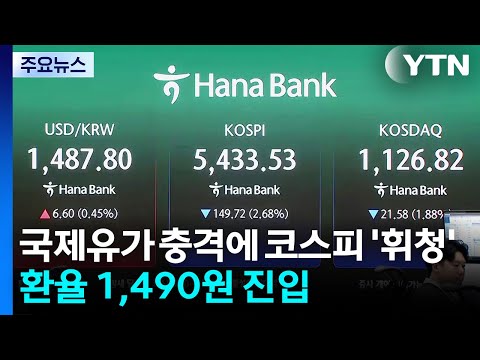
KOSPI Falls for Second Straight Day as International Oil Prices Surpass title: "국제유가 100달러 돌파에 코스피 연이틀 하락, 원·달러 환율 1490원대 진입"00, Won-Dollar Exchange Rate Nears 1,490 Won
Domestic Stock Market and Exchange Rate Trends
The KOSPI has fallen for two consecutive days, shaking the South Korean stock market, following news that international oil prices have surpassed $100 per barrel. During intraday trading, it briefly dropped to the 5,300 level. After opening at 5,412, down 3%, it is currently fluctuating in the early 5,500s. The index is declining due to simultaneous net selling by foreign and institutional investors, while individual investors showed bargain hunting, engaging in net buying of over 1 trillion won. Most top-cap stocks, including Samsung Electronics and SK Hynix, are currently declining.
The KOSDAQ market opened at 1,122, down 2.3%, but its decline narrowed over time, and it has now reversed to an upward trend. The shift to net buying by individual and institutional investors contributed to the index's rise. However, foreign investors have continued their net selling streak for three consecutive days in the KOSPI market and six consecutive days in the KOSDAQ market.
Surging International Oil Prices and Government Response
The price of North Sea Brent crude, a benchmark for international oil prices, has surpassed $100 per barrel, heightening tensions in the foreign exchange market. The won-dollar exchange rate climbed to 1,494 won in overnight trading and opened at 1,490 won in the Seoul foreign exchange market today. It is currently fluctuating between the late 1,480s and early 1,490s. This marks a renewed rise in the exchange rate, which had previously fallen to the 1,460 won range due to stable international oil prices.
This surge in oil prices is attributed to tanker attacks near the Strait of Hormuz and the new supreme leader of Iran declaring an ultra-hardline response against the United States and Israel. Even immediately after U.S. President Donald Trump mentioned an end to the war, North Sea Brent crude re-entered the $100 range, and WTI (West Texas Intermediate) prices also climbed to $98 per barrel. The South Korean government implemented a maximum price system for petroleum starting today to stabilize fuel prices. However, concerns are growing over whether oil prices can be stabilized as both international oil prices and the exchange rate are rising simultaneously.
*Source: YouTube: YTN (2026-03-13)*