Original Source

Middle East Tensions and Oil Price Surge Shake South Korea's Financial Market
International Oil Price Surge and Domestic Stock Market Decline
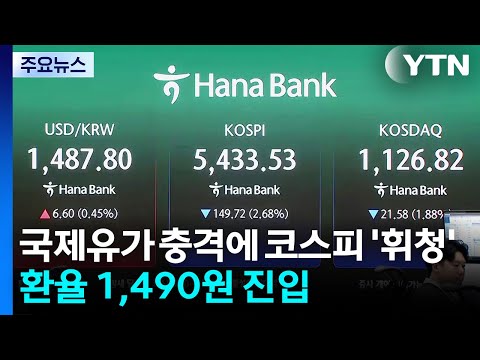
As tensions in the Middle East escalate once again, international oil prices have climbed past 100 dollars per barrel. Specifically, Brent crude reached $100.46 after Iran's new supreme leader expressed determination to blockade the Strait of Hormuz. The shockwaves were immediately felt in the domestic stock market, with the KOSPI initially falling by over 3% and at one point dropping below the 5,400-point mark. Despite sell-offs by foreign and institutional investors, strong buying from individual investors helped the KOSPI close the week at 5,487.24, a 1.72% decline from the previous day.
Increased Volatility in USD/KRW Exchange Rate and Market Resilience
Although the KOSPI continued its downward trend for a second consecutive day, its volatility has decreased compared to previous instances when oil prices first crossed the $100 threshold, which saw an 8% intra-day plunge and the activation of a circuit breaker. Park Seok-hyun, an analyst at Woori Bank, noted that this week's roughly 2% decline, in contrast to the previous week's nearly 20% drop, suggests the market is developing resilience. Meanwhile, the USD/KRW exchange rate, which recently fell to the 1,460 won range, started trading around 1,490 won due to surging oil prices. It closed the weekly trading at 1,493.60 won and even surpassed 1,500 won in after-hours trading for the first time in 7 trading days. The volatility of the won-dollar exchange rate this month is the highest since 2022, and this fluctuating trend is expected to continue for some time.
*Source: YouTube: YTN (2026-03-13)*