Original Source
One Quarter of Broadcast Journalist Roles Potentially Fully Replaceable by AI
AI's Potential Impact on Broadcast Journalism Roles
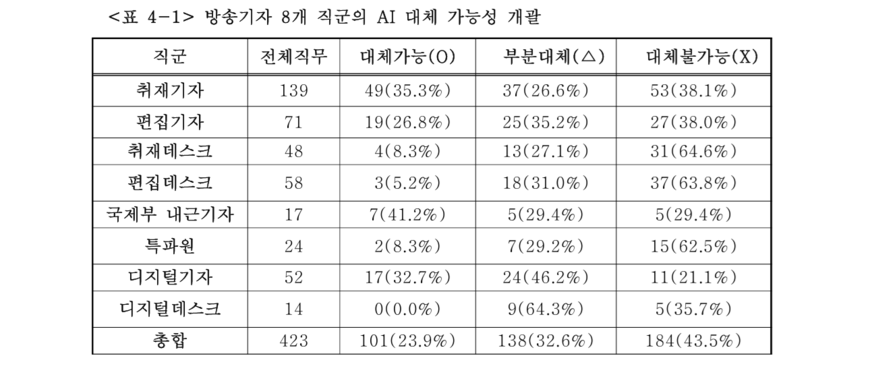
A study conducted by KBS journalist Kim Hak-jae for his Ph.D. dissertation at Korea University, titled 'Exploring the Substitutability of Journalist Competencies in the Age of Artificial Intelligence – Focusing on Broadcast Journalist Roles,' indicates that 23.9% (101 tasks) of broadcast journalist duties could be fully replaced by AI. Conversely, 43.5% (184 tasks) were found to be irreplaceable, and 32.6% (138 tasks) were partially replaceable.
The research meticulously classified 423 detailed tasks across 8 categories of broadcast journalism roles to empirically analyze the potential for AI substitution. These findings present a nuanced perspective on AI's impact on newsrooms, allowing for both optimistic interpretations, where AI poses less of a threat, and more cautious views, where AI represents a significant challenge.
Irreplaceable AI Domains by Job Category and Future Roles
The study also revealed substantial differences in AI substitutability across various job categories. Roles focused on management and coordination, such as editorial desks, reporting desks, and digital desks, showed a higher proportion of irreplaceable tasks. Notably, the digital desk category had 0% of tasks fully replaceable by AI. Similarly, roles requiring on-site presence and real-time response, like special correspondents and field reporters, also demonstrated large irreplaceable domains.
Key areas identified as irreplaceable by AI include 'reporting decisions requiring ethical judgment,' 'managing sources within complex human relationships,' 'immediate response to unpredictable field situations,' and 'creative planning and presenting differentiated perspectives.' This is attributed to journalism's social responsibility and public interest, which encompass social value judgment and ethical reflection beyond simple information delivery. The study projects that AI adoption will lead to an innovation in work methods and a redefinition of roles, rather than a complete replacement of journalists.
*Source: journalist.or.kr (2026-04-05)*