
Original Source
AI's Potential to Enhance Climate Migration Equity
AI's Role in Addressing Climate Migration
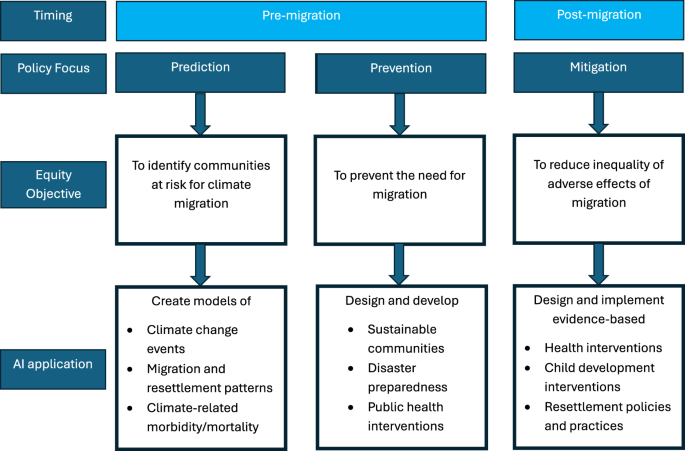
In recent years, the number of people displaced by climate-related environmental damage has significantly increased. These individuals, often lacking sufficient resources, are particularly vulnerable to social and health impacts. Emerging artificial intelligence (AI) tools and approaches offer potential to enhance the understanding of climate migration and immobility, facilitating timely and equitable interventions to mitigate harm before, during, and after displacement. While AI systems have been applied to climate modeling, disaster forecasting, and public health surveillance, their specific adaptation to climate-induced displacement remains underexplored.
Challenges and Research Needs for AI Implementation
AI applications can address the realities of climate migrants, such as anticipatory relocation, equitable health service provision, and sustainable infrastructure in host regions. However, challenges include the risk of fostering inequality through biased training data, the need for high-resolution localized datasets, prioritizing energy-efficient algorithms, and developing responsible AI governance models. Researchers call for empirical studies to document the effectiveness of current and proposed initiatives, overcoming methodological and operational limitations. Aligning technological innovation with human-centric values and rights-based governance could shift climate mobility policy from crisis response toward resilience-building.
*Source: Nature (2026-03-28)*


